
$26,000,000 Settlement in Drowning Case
Daryl L. Zaslow and Barry Eichen of Eichen Crutchlow Zaslow, LLP obtained a $26,000,000 settlement on behalf of two brothers who drowned at a public pool on June 8, 2022. The consolidated cases were resolved during a settlement conference conducted before The Honorable Joseph A. Turula, P.J.Cv. on November 13, 2025.
On June 8, 2022, Chu Ming Zheng was 19 years old, when he, his 15-year-old younger brother Jack, and their 11-year-old sister went to the Lincoln School Pool during open swim, which was open to the residents of Bayonne. The Lincoln School Pool was owned, operated and managed by the Defendant Bayonne Board of Education (“BBOE”). The school pool was a large L shaped pool with a shallow water kiddy section, a large (four feet deep) competition pool with lap lanes, and a separate dive well. The dive well was separated from the competition pool by a floating bulkhead.
Plaintiffs’ counsel and experts maintained that what made this dive well so inviting and dangerous was a shallow water shelf (four feet deep and seven feet wide) directly adjacent to the 13-foot deep section used for diving and immediately behind the bulkhead.
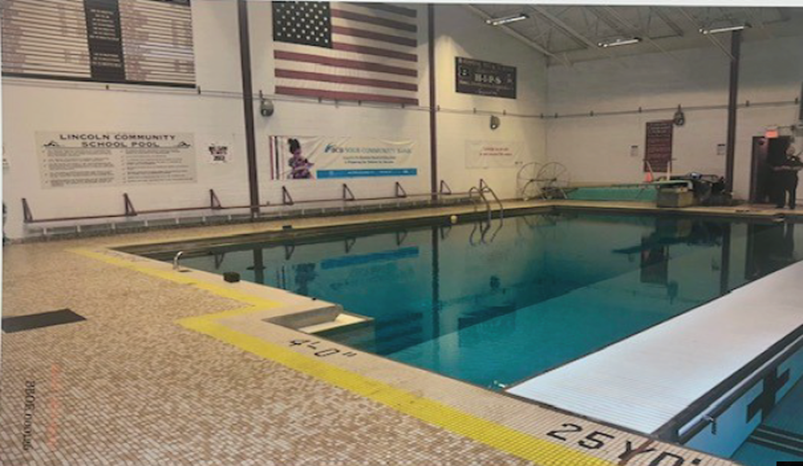
As seen in the above photograph, the dive well where the boys drowned contained a four foot submerged shelf on which most children and adults could stand, and a precipitous drop to thirteen (13) feet immediately adjacent to the shelf where a simple misstep would cause a person to be immediately submerged into the thirteen (13) feet of water.
The three siblings entered the shallow lap section of the swim pool (four feet deep) at about 6:20 pm and played in their own lane. Witnesses who frequented the pool on a regular basis and were familiar with the boys, agreed the boys were learning how to swim, were not proficient swimmers and needed to stand up or hold onto the wall after taking several strokes. All the witnesses, including several lifeguards, testified that the boys were polite, well-behaved, listened to instructions and did not engage in any dangerous activity or rough play. The testimony was also universal that and the boys would have complied with any instructions given to them by the lifeguards.
At some point during the evening, 2 witnesses observed the boys splashing and innocently playing on the four foot submerged shelf or standing area in the dive well. Although witnesses using the pool observed the boys in the dive well, somehow no lifeguard observed the boys leave the swim pool, walk to the dive well, enter the dive well or playing in the dive well. Additionally, although the BBOE and the lifeguards claimed that the dive well was supposed to be closed, witnesses testified that there were no signs, announcements, or barriers preventing anyone from entering the dive well, and no one ever instructed the boys that the dive well was closed.
A defendant lifeguard testified that at some point he saw boys struggling in the 13 feet of water adjacent to the 4-foot submerged shelf, but he did virtually nothing to rescue them. The lifeguard who first observed the boys struggling did not blow his whistle, activate an Emergency Action Plan (“EAP”), or enter the water to rescue the boys. Instead he walked to get assistance from 2 other lifeguards, one of whom was a lobby office and not even on the pool deck. Eventually, a second lifeguard arrived at the dive well when both boys were at the bottom. This lifeguard then entered the water to assist one unconscious boy to the surface but, after doing so, this lifeguard was too exhausted to try for the second victim and a Good Samaritan who was using the pool for exercise dove into the dive well and brought the second boy to the surface.
Eventually police and EMS responders arrived and transported the brothers to the hospital where both were pronounced deceased, with the cause of death for both listed as drowning.
There were no surveillance cameras that depicted the dive well, swim pool or pool deck, however, Mr. Zaslow and Mr. Eichen assiduously reviewed hundreds of hours of surveillance video which captured the lobby area of the school outside the pool deck, body camera footage taken by the investigating police officers and videos from interviews conducted by the Bayonne Police Department. They also retained 4 of the leading aquatics and lifeguarding experts in the country, in addition to several damages experts with expertise in drowning.
Plaintiffs maintained that when the boys drowned the BBOE had an insufficient and dangerous number of lifeguards patrolling the pool deck area. As per this issue, it was the safety policy of the BBOE and the management of the Lincoln School Pool to have at least three (3) lifeguards posted on the pool deck of the Lincoln School Pool at all times. Although numerous statements by the defendants were given to the authorities that 3 lifeguards were assigned and working on the pool deck, discovery revealed that was not the case. In fact, the Defendant lifeguards admitted at deposition that prior to the boys drowning there were never less than 3 lifeguards posted on the pool deck during open swim sessions, however, there were only two (2) lifeguards stationed on the pool deck when both these boys drowned.
Plaintiffs further argued that “every second counts” when lifeguards respond to an emergency and the BBOE did absolutely nothing to equip their lifeguards with the tools necessary to react appropriately to any emergencies or situations that required them to fulfill their job duties. The Plaintiffs argued that BBOE lifeguards were stripped of even the most basic training, and they were completely unprepared to handle the risks involved in safely operating the pool. The BBOE had no Emergency Action Plan or an Emergency Response plan in place at the Lincoln School Pool in the event of an emergency. There were no on-site drills, in-service training, audits or assessments or even any form of orientation to assist the lifeguards with their duties and help protect the children and patrons using the pool.
Finally, Mr. Zaslow and Mr. Eichen stressed that there were numerous simple and inexpensive safety measures that could and should have been implemented by the BBOE to make the dive well significantly safer for the children and people using the pool. The photo below demonstrates just a few of the simple and inexpensive measures that numerous Defendants admitted at deposition could and should have easily been taken by the Defendant BBOE to make the dive well substantially safer.
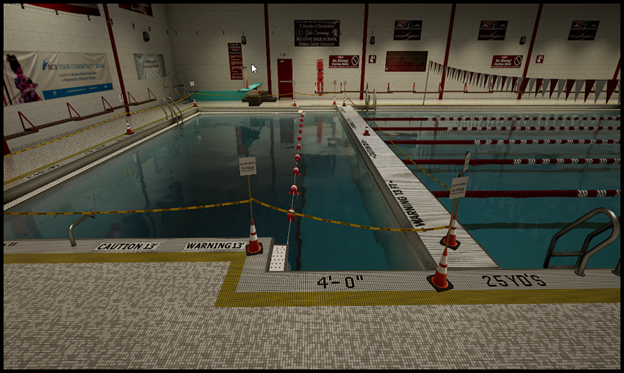
As depicted in the above photograph, Plaintiffs maintained that some of the safety measures that should have been taken include:
- Floating Safety line with buoys across the dive well to show the location of the dangerous ledge and that swimmers could grab when needed. The hooks for such a safety line already existed in the pool but a floating safety line was not used;
- Warning signs that the dive well was closed and that no lifeguard was guarding the dive well;
- Caution tape signaling closure of the dive well area;
- Traffic Cones with a sign on a broom stick clearly warning that the dive well was closed;
- Painting the submerged ledge a different color to make the dangerous drop-off to 13 feet visible;
- Warnings signs of the change from 4 feet to 13 feet on the pool deck and bridge.
Despite the simple and inexpensive options available to the BBOE to make the dive well substantially safer, the BBOE left the dive well in the dangerous condition depicted below.
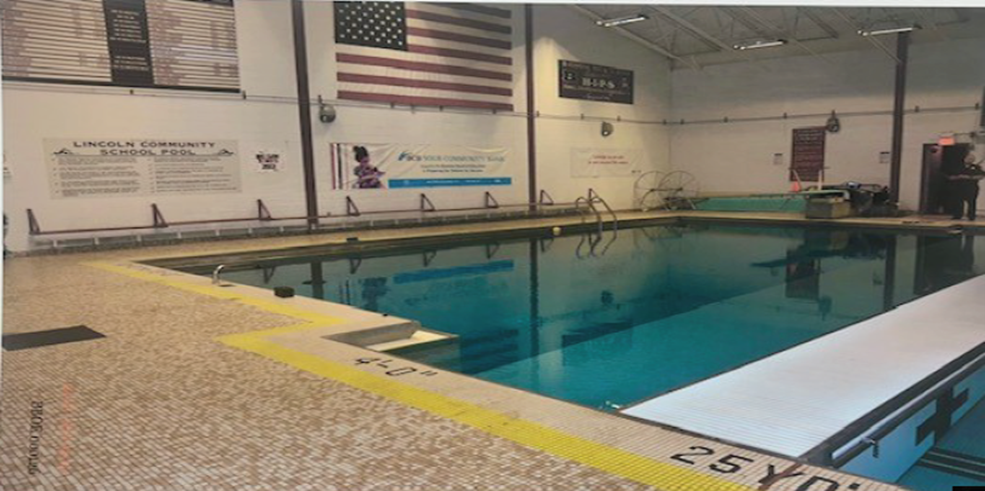
(Photograph of Dive Well as it existed on June 8, 2022).
Prior to the case settling during the settlement conference before Judge Turula on November 13, 2025, the parties participated in several days of mediation before The Honorable Raymond Reddin, J.S.C. (Ret.) that were also instrumental in the negotiation process.
Mr. Zaslow and Mr. Eichen retained 14 experts and worked with a team of experts to create a 3D Interactive Digital Presentation of the entire Pool Auditorium, which was a powerful tool when conducting depositions and presenting the case during mock trials. “We spared absolutely no expense in prosecuting this case and I am extremely proud of our entire firm in achieving this result,” Mr. Eichen said.
Mr. Zaslow stated, “The enormity of this tragedy is inestimable and it is certainly understandable why this case has received so much attention from the media and the public. As such, for the last 3 years I have remained acutely aware of the enormous responsibility we have had in representing this family, especially given the magnitude of their loss. Although no amount of money can turn back the clock and erase the damages, I am certain we did everything possible to achieve this result.”
The settlement is being paid entirely on behalf of Defendant BBOE. Defendants BBOE, Corey Kettleman, Lisa Kohler and Alex Mariak were represented by Roshan Shah, Esq. and John Regina, Esq. of the Shah Law Group in Shrewsbury, N.J. Defendants Ashley Danback and John Rickard were represented by Dawn Attwood, Esq. and Erik Corlett, Esq. of Attwood Corlett, LLC in Paramus, N.J. John Nulty, Esq. of Cammarata, Nulty & Garrigan, LLC, in Secaucus, N.J., also represented Corey Kettleman in defense of the claims for punitive damages. Christopher Patella, Esq. of the Patella Law Firm in Bayonne, N.J., also represented Ashley Danback in defense of the claims for punitive damages. Qinglin Zheng Wong, Esq. of QLW Law Group in Flushing, N.Y. referred the case to Eichen Crutchlow Zaslow, LLC and entered an appearance as co-counsel for the Plaintiffs.